
No snow? No problem. Londoners are turning tarmac into a winter workout playground.
It’s 9am on a drizzly Saturday in Kensington, and people have come to Hyde Park for a walk, run, cycle or ski.
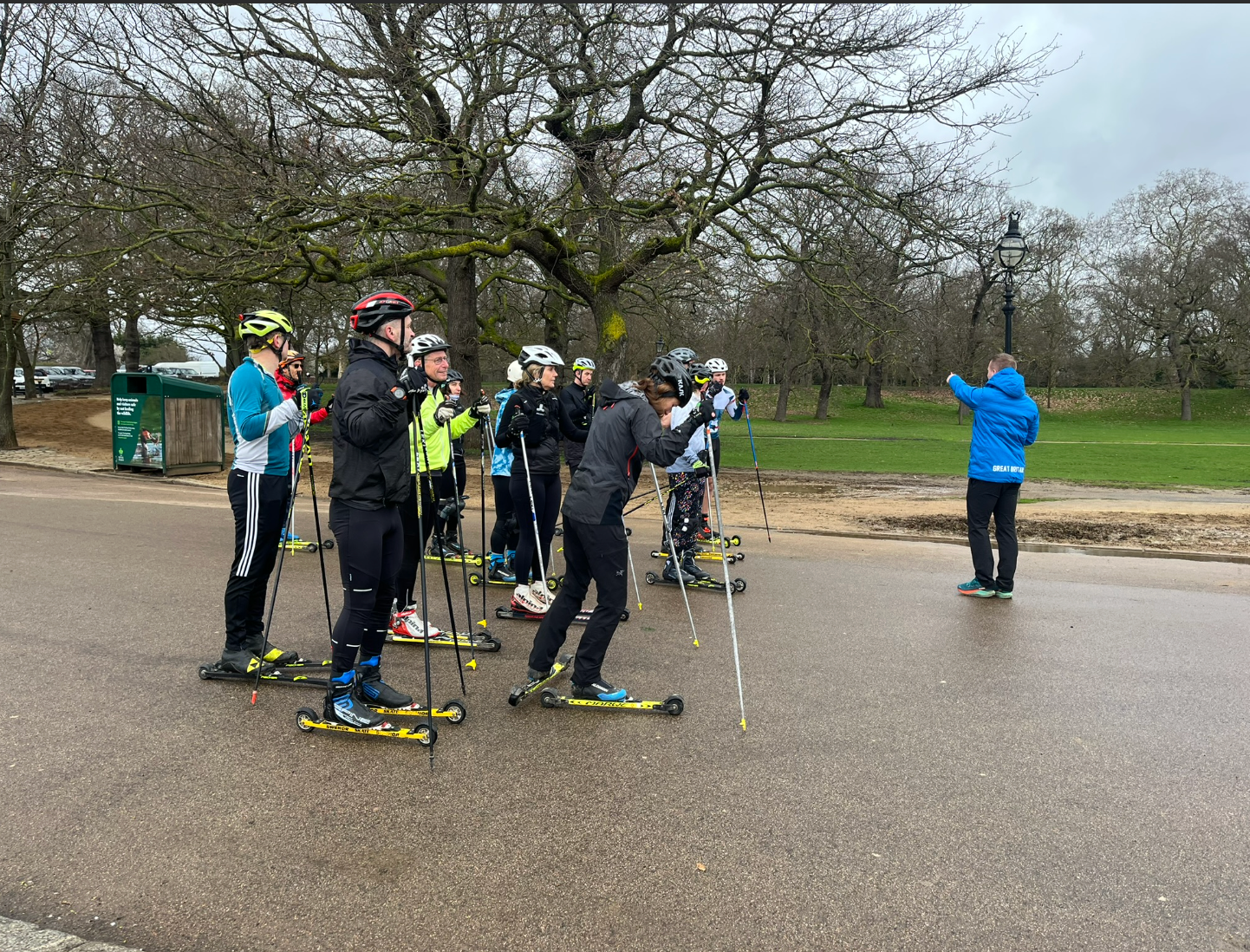
No, it hasn’t snowed. In a car park overlooking the Serpentine, members of the London Cross-Country Ski Club are stretching and putting on shin pads, getting ready for a morning of rollerskiing.
“I was just in Andorra on a family ski trip,” says one woman, shifting her skis from side to side to keep warm, “But I didn’t ski. I don’t like downhill skiing.”
Rollerskiing was recognised as a sport in its own right in 1992. Rollerskis are slightly shorter than normal skis, and have two wheels, similar to those of rollerskates, at the front and back. They look a little like the base of a slim scooter. Rollerskiers use poles and skating motions to move, as if they were cross-country skiing on snow. But they’re not: they’re skiing on tarmac.
The 2026 Winter Olympics have brought renewed interest in the sport. Commentators on the cross-country skiing events are sometimes rollerskiers themselves, and will often mention rollerskiing as a way to enter the sport in less snowy countries. “There’s an uptick every four years when people find out about it,” a man in a British Biathlon Team outfit tells me. “Lots of people come for a few weeks, then it dies down.”
But it doesn’t die down completely. Today, there are more than twenty people – half men, half women – gathered to ski, and the club has 40 members. Another group, the London Region Club, rollerskis around Richmond Park. There are also rollerskiing clubs in Manchester and Leeds, plus a few in Scotland. Serious snow skiers use rollerskiing to continue their training during the summertime, but most people today are just here for enjoyment.
“Hyde Park might seem safer than mountains, but there isn’t any snow to cushion a fall”
Jordan Andrews, head instructor of the London Cross-Country Ski Club, is handing out skis and helmets from the back of a blue van, chatting with everyone. “We also get a lot of people who just come for the social side of things,” says Andrews. “They’re not really here to compete, they’re just here to get some exercise, have a bit of a gossip and a coffee after.”
Its appeal is not unlike that of run clubs, which have seen a surge in popularity– particularly among young people – in recent years. Engaging in endurance sports has become a social activity for many in their twenties who are drinking less on the weekends, with hangover-free mornings to spare. Some of the people here this morning have done ski marathons – whether on snow or on wheels. There is a rollerski marathon in Lake Saimaa in Finland; the Orlicky Rollerski Cup takes place in the Orlicky mountains on the border of Poland and Czechia; and the Vaajmarathon is a rollerski race crossing the Norwegian-Swedish border. The potential to travel for races and meet other skiers is part of the appeal, says Andrews, who used to compete and now coaches the British Nordic Ski Team.
Today, some of the skiers will do a half marathon – two-and-a-bit laps of the park – while others are sticking with 10km. One woman has been coming here for nine years, and another is on her second session. “The youngest club member we have right now is twelve,” says Andrews. “Our oldest member is 80-plus, and we have everyone in between.” Last week they had an event for children to tie in with the Winter Olympics. They start beginners on grass rather than the road. Hyde Park might seem a less dangerous arena than mountains, but there isn’t any snow to cushion a fall. “Obviously you’re on tarmac which can be a bit daunting, especially if you’re nervous,” says Andrews. Even once they move onto the harsher surface, novices start with one ski – like a scooter – to get them used to the feeling.
Rollerskiing might look slightly less elegant than alpine skiing, thanks to the shin pads, bicycle helmets and grey skies of Hyde Park, but it’s no easier. In my conversations with the skiers, I am reminded that rollerskiing is very much still skiing; any time I ask a question about the difference between “rollerskiing” and “skiing”, their answers refer to the latter as “alpine skiing” or “skiing on snow”.
“It’s using all the same muscles,” says Andrews. “To start with it can be a bit harder because you’re slightly higher up off the ground than you would be on snow.” The movements are similar: on rollerskis, as on traditional skis, you stop using a “snowplough” (putting your toes closer together so the skis make a triangular shape). As my friends who commute through Hyde Park – and dodge the skiers training on a Tuesday evening – remind me, the rollerskiers can be fast. In races, some will reach 50km per hour, or more if they’re going downhill. In an average session, though, Andrews says most skiers are moving between 8 and 12km per hour.
“A part of me wishes that instead of walking through Hyde Park, I was skiing through it, too”
Eventually, everyone has arrived, and the skiers skate – ski? – from the car park to their starting point by the lake. They gather at the starting line, and one man laughs as he is sent back to get a helmet, before racing to catch up. The half-marathoners set off first, and then those doing the shorter route. Some are going for time, others have headphones on or are chatting as they go. When I leave the park later, I walk past some of them in the middle of their route. They give me a big smile and a wave. A part of me wishes that instead of walking through Hyde Park, I was skiing through it too.
The London Cross-Country Ski Club trains on Tuesdays and Saturdays in Hyde Park. One rollerskiing lesson, including equipment, is £40.