
From waterfalls that mask the crowd to libraries where whispering is a push, I searched for London’s quiet places with a decibel app, measuring the noise and questioning whether peace is something you hear or something you sense.
I’m sure when Simon and Garfunkel wrote The Sound of Silence, they weren’t thinking about me holed up in a North London flat, scowling at a city that never shuts up. Sometimes I like that London is so loud. There are nights when its noise feels like part of the deal, with the clamour of pub conversations and blaring neon rickshaws. It can feel oddly cinematic, like you might encounter Hugh Grant tripping down a cobbled street.
Most of the time, though, it’s less charming. It’s the boiler clearing its throat, bass bleeding through the wall, the distant metallic shiver of a train you can’t see. It is often the sound of London reminding you it’s still there, just in case you were about to forget.
Somewhere between the boiler and the bassline, I started wondering what silence even means in a city like this and whether it exists at all. So I went looking for it, decibel app in hand, spending time in London’s supposedly quiet places and paying attention to what I could hear, how loud it really was, and whether any of it actually felt like peace.
Kyoto Garden, Holland Park
I started at Kyoto Garden because any list of ‘peaceful places in London’ describes it as an oasis you can reach on the tube.
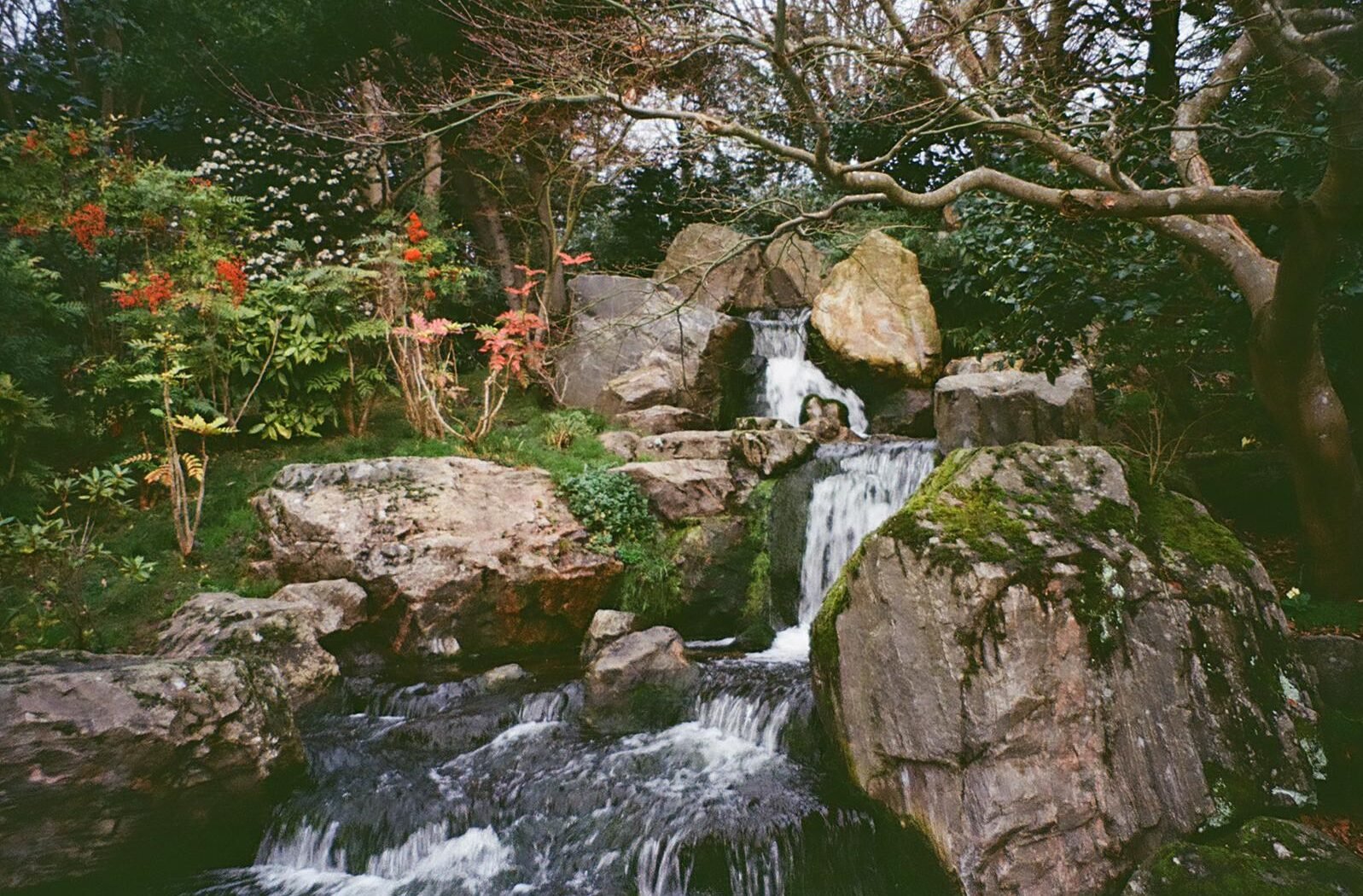
It opened in 1991 as a gift from Kyoto to mark friendly ties between Japan and the UK. The garden is small with a tiered waterfall, koi pond, stone lanterns, clipped paths, and cherry and maple trees that take turns being beautiful depending on the season.
On paper, it shouldn’t work for quiet. It’s free, famous, and compact, which usually means suffocating crowds. Even at 63–75 dB (about the volume of normal conversation), the waterfall dominated the soundscape and the footsteps and snippets of talk were smoothed down into the background. Water is a useful kind of noise when you’re alone. I felt calm because there was one main sound and it didn’t require me to respond.
That calm lasted until I got closer to the pond and a group of unsupervised children started sprinting around the edge. My body went from relaxed to alert, and I became aware that someone could slip, or slam into the back of my knee and send me face-first into a koi pond. Kyoto Garden gave me controlled sound and a reminder that peace also depends on how safe your nervous system feels.
“I started wondering what silence even means in a city like this and whether it exists at all.”
Hampstead Heath
Hampstead Heath’s ponds are one of the few places in London with an actual claim to quiet. In 2021, Quiet Parks International named the Heath Europe’s first ‘urban quiet park’, based on the idea that you should get stretches of sound dominated by nature rather than engines.
It has history on its side. John Constable painted the Heath in the 1820s, when it was still open windswept ground at London’s edge. As the city expanded in the nineteenth century, campaigners fought to keep it wild. The Corporation of London has managed the Heath since 1989, with the unglamorous job of maintaining a landscape that’s constantly trodden, swum in, picnicked on and walked through.
I went early on a weekday because here, ‘peace’ is mostly a scheduling problem. It was one of those sunny breaks after days of rain, so the Heath had drawn a bigger crowd than I expected – dog walkers, couples, and swimmers making brave choices – but it still didn’t tip into crowd-noise. My decibel app sat around 53–58 dB. Still not silent, but low enough that sounds separate instead of congealing into one constant roar.
Ibraaz
I wanted to visit a library because it’s impossible to think about ‘quiet’ without summoning the librarian archetype: someone materialising at your shoulder to hiss the word shhh directly into your face. The obvious choices, the grand, instagrammable ones like the British Library felt a bit like cheating, so I went to Ibraaz instead. It’s a five-floor space on Mortimer Street that’s part library, part bookshop, and part café. As a UK-registered charity focused on art, culture and ideas from the global majority. There are exhibitions, talks, screenings and residencies throughout the building.
Which is exactly why the foyer threw me.
A couple of people were talking like they had never once been asked to use an indoor voice.That definitely wasn’t the vibe I’d expected from anywhere with books in it, but beyond that bottleneck, the library cohered with the stereotype. My decibel app hovered around 53–56 dB, one of the lowest readings I’d had so far, and it felt quiet too. There were sparse desks, a few chairs placed around the room, as well as a big cushioned seat where people were folded into themselves, reading.
“It’s the boiler clearing its throat, bass bleeding through the wall, the distant metallic shiver of a train you can’t see.”
St Dunstan in the East, Church Garden
St Dunstan-in-the-East felt the quietest place by far, and my app hovered between 53 and 56 dB, which isn’t dramatically lower than the library, but it certainly felt different. The city was still there in the background, but inside the ruins, the noise was dimmed.
Surprisingly, there weren’t many tourists, just a few people reading on benches. The air felt as though it had paused.
Maybe that’s the trick; silence in London is less about the absence of sound than the city noise retreating just enough that you can stop bracing for it. In the middle of bombed-out stone and creeping greenery, I realised I wasn’t listening for the next interruption. For a moment, nothing seemed imminent to happen, and that was where I was at my calmest.