
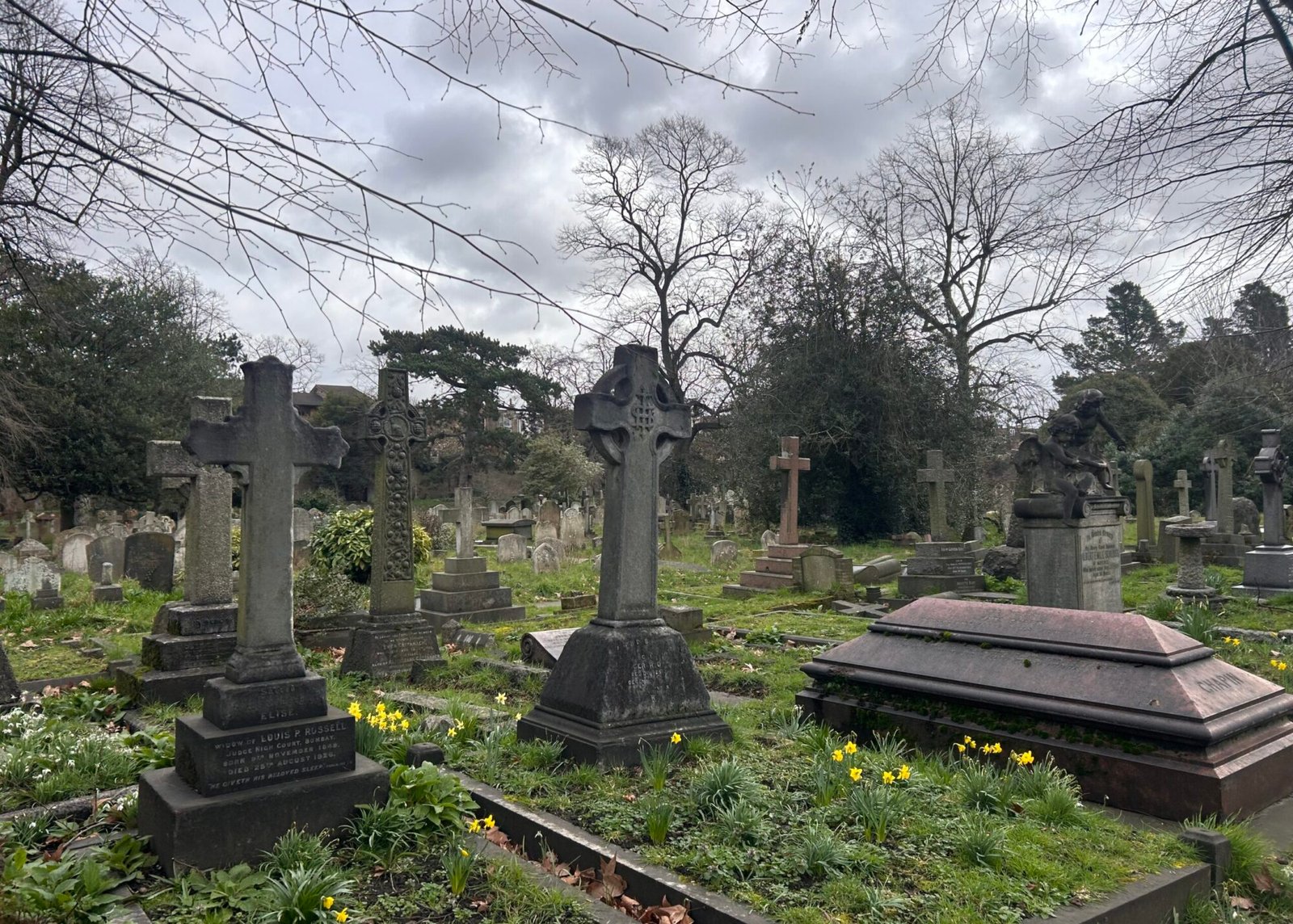
Out of respect for the living, cemeteries are considered hallowed ground – but is it time we think about these spaces differently?
Highgate Cemetery is teeming with life. Sprays of daffodils bud between gravestones and fresh bouquets rest on graves. The whirr of a distant lawnmower and the first trills of birdsong fill the air. Visitors who mill about seem to be at ease with the cemetery being as much for the living as it is for the dead.
Soon, this peaceful pocket of London will undertake a 25-year long makeover costing £18m, approved by Camden Council last November. Focused on improving public access to the grounds and repairing biodiversity, walkways will be re-pathed, the Victorian drainage system will be replaced and toilets are to be installed for visitors. The cemetery’s entrance will be restored, and six new buildings, a cafe and an education centre will be constructed.
The major undertaking has been in the works since 2019, requiring comprehensive consultation with grave owners and English Heritage.
“We’ve done years of conservation engagement on the plans for the project and have been working with local groups,” says Emily Candler, head of public programmes at Friends of Highgate Cemetery Trust. “We want to help people feel welcome here and broaden the range of people who experience the cemetery,” she continues.
Last August, a proposal was scrapped to build a toilet block and gardener’s facilities on a mound near several burial places following dozens of objections from the community, with some relatives threatening to exhume their loved ones.
“It’s a place for walking around quietly and contemplating.”
The tension at the heart of the project is whether the space is designed for the living or the dead, and who takes priority. “I do a lot of work with the community and some people question whether it’s appropriate to visit a cemetery as a tourist,” continues Candler. “It’s not something that everyone is used to in every culture.” Since the pandemic, the number of visitors to Highgate Cemetery has risen sharply, reaching 110,000 last year, following a steady year-on-year increase. Tourists regularly form long queues at the cemetery’s gates.
Cemeteries and graveyards are simultaneously a public and private space, making the ethical grey area of cemetery tourism subjective. The Magnificent Seven – a ring of seven large Victorian Gothic cemeteries around London – has long attracted tourists to its storied grounds. As well as being tourist beauty spots and history-buff magnets, over the years they’ve served as ‘third spaces’ for a variety of leisure activities. Kensal Green regularly doubles as a shooting location for films, and has hosted open-air horror cinema events.
However, some activities have been criticised for being insensitive to the dead. From reports of London cemeteries being Pokemon Go PokeStops and gay cruising hotspots, the limits of acceptable cemetery behaviour are continuously being pushed. Putney Old Burial Ground was once home to a fitness club owned by former British Olympic athlete Daley Thompson. And further afield, the dispute over goths staging photoshoots in cemeteries during the biannual Whitby Goth Weekend has been documented for decades.
Highgate is selective about the events it hosts as a working cemetery which holds burials throughout the year. “We don’t allow things that other cemeteries might allow – we don’t do anything spooky or ghost related,” says Candler. “We wouldn’t ever expect to see anyone jogging. It’s a place for walking around quietly and contemplating.”
Tom Walker, chair of Abney Park Trust, another ‘Magnificent Seven’ cemetery, takes a similar view. “Some people express concern that things like outdoor summer theatre might involve people dancing on graves. No, they won’t, but [these events] involve this sort of judgement.” He continues: “Anything that is gratuitously spooky or ghost story-themed is a grey area.”
Fiona Bawdon, a legal affairs journalist, buried her baby daughter years ago in Highgate cemetery, just a few metres away from Karl Marx’s grave. When Marx’s grave was desecrated in 2019, it shook her deeply, a reminder that even the most sacred of resting places are not beyond violation. After the incident, she wrote on her blog: “Out of respect for the living, a cemetery should be hallowed ground. It’s where people go to grieve.” It was a place that, beyond allowing her to remember the past, had helped her survive the present. “I used to go, sometimes daily, to avoid being capsized by very raw grief,” she says.
Bawdon still feels that the activities held in cemeteries are only acceptable around ancient graves, not those that grieving people still visit. “If you’re going to be compounding people’s grief, then I would absolutely have a problem with that.”
“You can’t trample over the rights and feelings of the grave owners.”
Still, Bawdon does not believe that people coming to appreciate the beauty or history of cemeteries should be excluded. “These are public spaces, and maybe there aren’t enough of them,” she says.
“Death is a part of life,” Bawdon continues. “You can’t trample over the rights and feelings of the grave owners, but equally the cemetery costs a lot to maintain and people want to come in and see famous graves.” It was important to Bawdon that her daughter was given her own tangible place in history, laid to rest in the company of luminaries like Karl Marx, George Eliot and Christina Rossetti.
Many consider cemeteries educational sites, doubling as public history archives. Andreane Rellou, actor and TikTok creator, is a keen taphophile – or tombstone tourist – and posts feminist historical content to her 28,000 followers. Her aim is to spotlight female figures who might otherwise have been forgotten by history: “In history, we always talk about men and we forget the stories of women. But when it comes to cemeteries, everybody’s equal,” says Rellou.
Rellou documents her visits to various graveyards on TikTok, researching those buried there, exploring what narratives and characters lie beneath the earth. Her favourite, she says, is West Norwood cemetery – part of the Magnificent Seven – thanks to its Hellenic-inspired architecture and the large proportion of Greek Victorians who chose to be buried there.
In one video, Rellou places flowers on the grave of Maria Cassavetti Zambaco, a 19th-century model who posed for pre-Raphaelite artists including Dante Gabriel Rossetti and Edward Burne-Jones. With her long hair and pink gauze dress, Rellou herself would not look amiss in a painting of the period. She finds visiting graves to be a joyful experience, and says “it feels like a really respectful thing to pay homage” – especially to women who would otherwise remain in relative obscurity.
“I think cemeteries are for the living,” Rellou says. “Visiting them is a history lesson, so that the world doesn’t forget these people – especially when it comes to women’s history.” In 2024, Rellou, after posting a viral Tiktok, solved a 100-year mystery involving a portrait of unidentified women at Brighton Museum, showing how simply engaging can reveal otherwise forgotten chapters of history. “It’s how we keep engaging with these figures, so you’re able to form a relationship and make them more real in your head.”
Brompton Cemetery, another of the Magnificent Seven located in Kensington, is regularly gardened and maintained, and visitors have always been invited to use and appreciate its sprawling 39 acres. With its own visitor centre, cafe and toilets, the cemetery bustles with constant activity, from dog-walkers and runners to tourists, ensuring that the dead buried there do not go unobserved or forgotten. Along the central walkway, one tombstone with a faded Celtic cross stands out among the rest. At its foot are a bunch of flowers and a note. “Dear Emmeline,” it reads, “Thank you so much for all that you did to better the lives of generations of women.” Its addressee is the suffragette Emmeline Pankhurst.
For many cemeteries, preserving the past means thinking about the future. Highgate’s revitalisation project promises to do that. Those like Bawdon whose loved ones are resting there should be assured that the cemetery’s primary function is being adequately protected, without becoming rarified. Without a space for the living to remember, those who have passed will be forgotten.
In Highgate, the tomb of Mary Ann Eliot, better known as George Eliot, author of Middlemarch, has two prescient lines of her poetry inscribed: “Of those immortal dead who live again / In minds made better by their presence.”