
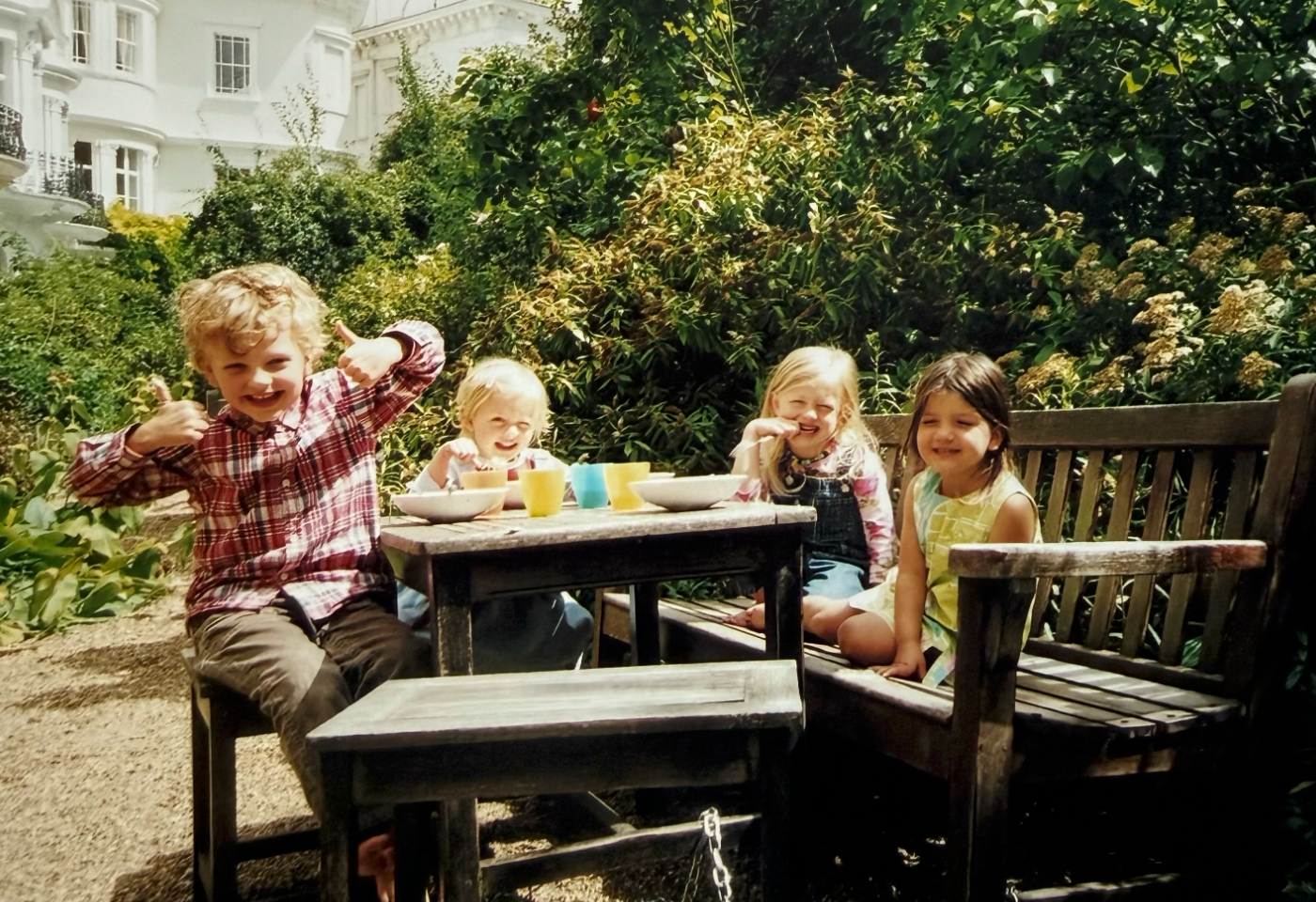
Behind the terraces of North Kensington sits a communal garden with a long history. I grew up beside it, and it became the backdrop to my childhood.
When I was two, my mum, sister and I moved to Stanley Gardens in North Kensington, London. The area is made up of five-storey Victorian stucco mansions that have always reminded me of wedding cakes with their cornices and wrought-iron balconies. Behind these towering white terraces lies a communal garden – an acre and a half of trapezoidal greenery.
The Stanley Gardens plot dates to the 1840s, when James Weller Ladbroke began transforming his family’s agricultural estate into what would become the Ladbroke Estate. Architects at the time believed that enclosed, shared gardens would elevate both the value of a development and the character of its residents. Dozens of these ‘pleasure grounds’ were laid outcross Kensington and Chelsea in the nineteenth century. Green space, if kept private and well-tended to, was thought to evoke health and civility, a necessary antidote to the soot and congestion of Victorian London.
Kensington and Chelsea contain the highest concentration of communal garden squares in the city. Forty-six of these levy an annual charge, collected through council tax from residents whose properties entitle them to a key.
To hold a key to one of these gardens, you must first hold a key to the surrounding mansion. In other words, you had to be extravagantly, comically rich – which we were not.
My mother was offered a flat in a building overlooking the garden, one of roughly 60 council flats run by the Women’s Pioneer Housing Association. Founded in 1920 by the Irish suffragist Etheldred Browning, the organisation provides secure housing for single women, many of whom are escaping domestic violence, homelessness or other forms of precarity. This is how we came to share a garden with investment bankers and minor aristocrats. One in four children in the borough grows up in poverty, yet it is also home to the likes of the Beckhams. The poor are quite literally sandwiched between the obscenely wealthy. Some even share a back garden.
I rarely saw anyone in the garden besides me, my sister and two boys who lived ten houses down, whose house sat at a right angle to ours. Those boys became our best friends and remain among the most important people in my life.
“For us, the garden was everything: wilderness, kingdom, stage set.“
There were a few exceptions. In the summer, there was a party where adults wore white linen, sipped warm prosecco and gathered around a chocolate fountain slowly melting into itself. Another exception was Guy Fawkes Night. Otherwise, Stanley Gardens was quiet.
My sister and I were in the garden almost every evening until we became teenagers. We invented elaborate imaginary worlds, mapped out over days. We stole long bamboo sticks from the gardener’s pile and turned them into swords and magic staffs. Time was slower back then. The hours felt epic. I would dread it when the light started turning blue because it meant our time in the garden was coming to an end, and we would be called inside for a bath soon. We would return caked in mud, grass clinging to our shins. Later, submerged in warm bathwater, I would stare at the bruises emerging on my knees and watch the dirt dissolve into the water. For many of those who technically owned it, the garden was little more than an amenity – a line on a property listing. For us, it was everything: wilderness, kingdom, stage set.
We moved in 2017, leaving behind our cat, called Stanley. He moved in with our neighbours. It didn’t feel right to separate him from his namesake. The cat has become immortalised in my mind, forever stalking the trees around his garden.
A year after moving into our new flat, we watched Grenfell Tower burn from our window. The following morning, we picked up debris and children’s scorched homework from our new backyard. Behind the white mansions of Stanley Gardens, I’m sure the impact was hardly noticed.