From underground battles in Kentish caves to running the UK’s national LARP awards, Ian Knope has spent nearly four decades immersed in the world of live action role play
Picture a group, mostly male, running around a park dressed up in elaborate costumes and armed with gear from the past or a fantasy world, pretending to beat the shit out of each other. Now, imagine this was your route out of unemployment as a young, eccentric twenty-something.
This was Ian Knope. After graduating university in 1993, he became a permanent staff member at his part-time job, making latex and plastic weapons to sell to members of Labyrinthe, a live action role playing (LARP) community based in Kent.
Knope, originally from Walthamstow in East London, has nurtured his love of the hobby since his late teens, acting out characters drawn from imagined and historical worlds or helping others to do so.
He now runs one of the largest national events for the scene, the UK LARP Awards at the annual convention LARPCon.
“I grew up as a child with the fantasy books my father bought me and my sister, role playing on tabletops with the neighbours. It was all leading to my first LARP with a bunch of friends at Chislehurst Caves in 1988,” Knope fondly remembers.
His interest in designing weapons for events began when he would practice in the local woodlands with a friend who lived on the same street. He says, “We didn’t always have latex or plastic swords back then and we would use sticks, which means we got very good at parrying to stop getting hit.”
Over the phone, Knope sounds exhausted from preparing the UK LARP Awards for months and hosting the event last weekend. He has become a formidable member of the community.
The entire global market for LARP has now been valued at around £430 million in 2024 and is projected to reach a revised size of £750 million by 2031, almost doubling in six years.
“When the craze hits you young, it becomes an obsession quickly. I have followed live role-playing since it was fresh and new in the 1980s but I was too young then to head up to Cheshire from London to play at Peckforton Castle where the first large-scale battles were held,” Knope says.
Peckforton Castle hosted the first recorded LARP event in 1982, organised by a group called Treasure Trap. The organisation closed two years later for financial reasons and splinter organisations such as Labyrinthe, the first group Knope got involved with, set their sights on a location closer to the growing London network.
“We are just idiots rolling around in the mud.”
A recent survey by the national convention for LARPers found that people are willing to travel to attend a live event. Though, as participants admitted, they would not be likely to drive or catch a train for longer than 2 hours.
“If people have to travel more than a couple of hours they won’t be happy about it. I find that most people think an hour’s drive is perfect to attend a LARP,” Knope says.
“Labyrinthe still runs every weekend at Chislehurst Caves,” he says. “It’s an old chalk mine, so inside it’s black as pitch and the floor used to be uneven. People still run into walls and twist their ankles, but health and safety has become much better than it used to be.”
Knope is quick to stress that though there is more regulation around protecting players, their inventiveness hasn’t been curbed. “We haven’t even stopped using small-scale and controlled explosions,” he adds.
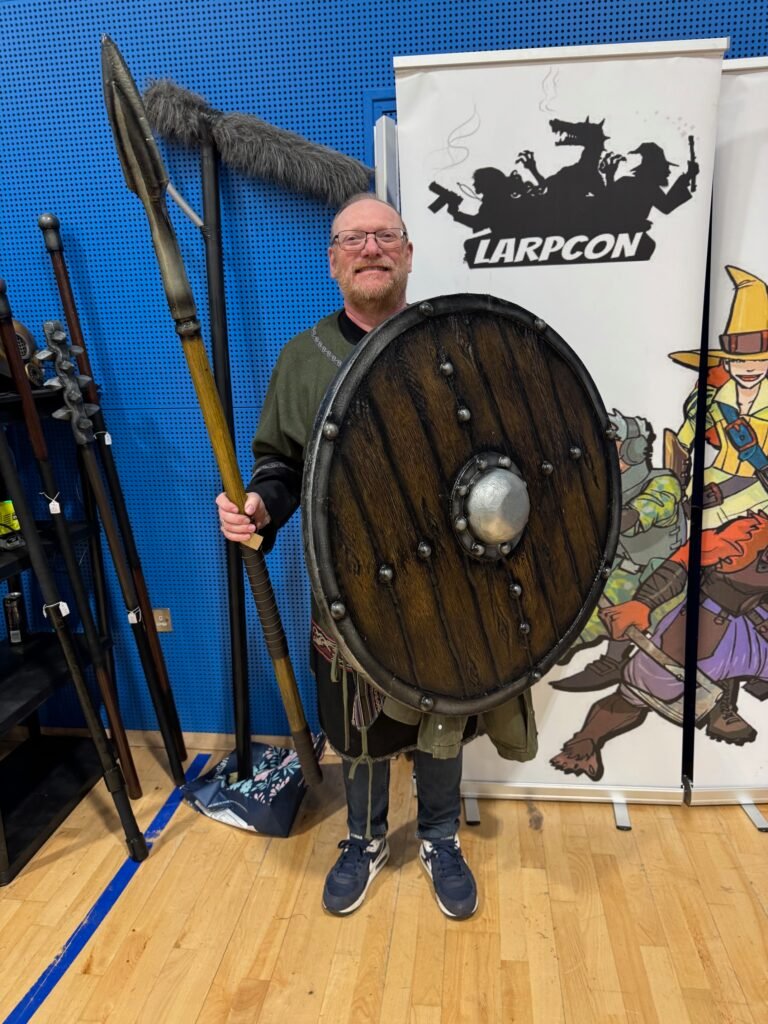
“Of course, we never use them to cause harm but LARPers have gone away and qualified themselves in explosives so that they give that edge in mock battles.” Some community members who have been working since the 1980s have grown such a talent that they ended up working in Hollywood in the props, costume and special effects departments, Knope explains.
Knope started the UK LARP Awards at LARPCon in 2011 with his wife at The Elite Gaming Lounge, Coalville in Leicester. “We got married in 2009 and moved to Norwich with another LARP weapon maker, selling role-playing equipment to locals through my company Having a Larp.”
“In the 1980s, there was about one woman to every 20 men, and it was unfortunately a place where many players got their girlfriends nicked.”
Over the years, LARPCon has grown from a large hall of vendors selling equipment into a room full of promoters for events. It hosts talks, panels, an art gallery and a live auction for gear and armour. “It has expanded into a proper convention rather than just another event with a silly joke name,” Knope says.
In 2026, LARPCon raised money for The National Autistic Society and has supported Mind, a mental health charity, in the past. “It just made sense to support these causes as many of our players and participants deal with these issues,” Knope adds.
It’s important to get a mixture of storytelling, mock fighting and different types of player-to-player interaction in LARP events, which can run for days.
“If someone turns up in a wheelchair, or on crutches, it’s important that they aren’t matched up against a six-foot bloke with a fake blade, shield and plate mail,” says Knope.
He has noticed that LARPing now attracts a much wider range of people. In particular, more women: “In the 1980s, there was about one woman to every 20 men, and it was unfortunately a place where many players got their girlfriends nicked. Many male players were always worried about that, but I suppose there is that element in any social group.”
Over the years, these activities have also become much more professional than when they first started. “I began LARPing for a bit of a light-hearted chuckle. Some of the national communities have even been negative about me starting something like the awards ceremony, thinking it would add an unnecessary level of seriousness to the events,” he adds.
Knope still believes that the hobby relies on players approaching the meetings, battles and conventions playfully. “It’s supposed to be stupid and funny. At the end of the day, however professional it becomes, we are still just idiots rolling around in the mud,” he says.
Photos by Lex Charles and Malcolm Hall