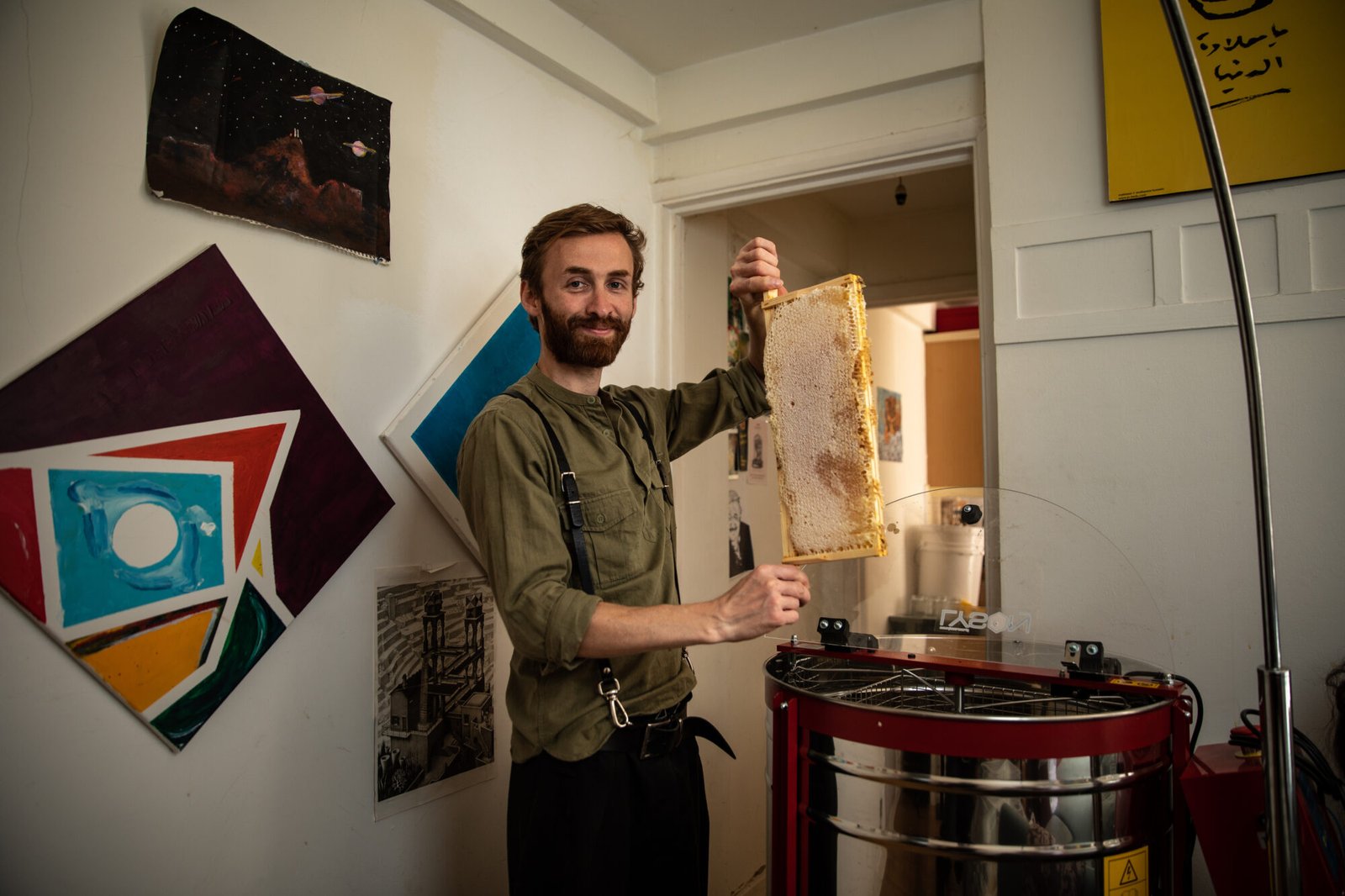
In 2020, Ali Alzein founded ‘Bees and Refugees’ to reconnect with his origins on his grandfather’s farm in Syria. Six years later his organisation is providing a community for London’s beekeepers.
It’s a Friday in Al Ghutta and Ali Alzein is ten years old. He is visiting his grandfather, a farmer who owns land in the fertile Syrian countryside. The famous greenbelt surrounds parts of Damascus, Alzein’s hometown, and is home to many of the crops which feed neighbouring cities.
“Al Ghutta literally means, ‘a land filled with greenery and wildlife’,” says Alzein, many years later. Over time, weekend visits to his grandfather ignited his fascination with bees. Other farm animals roamed around, but when Alzein tended to the hives, lighting the bee smoker for his grandpa, he felt incredible.
In 2011, Al Ghutta turned into a battlefield. Trees burned, poison gas attacks ensued and houses were destroyed. Alzein’s grandfather’s farm did not survive the warzone.
Eventually, Alzein’s family relocated. His sisters moved to the UAE, Michigan and Los Angeles and Alzein, age 40, works in London as an urban beekeeper.
When the insects are buzzing, he says, his mind is quiet and present. As he pulls frames from a hive, Alzein doesn’t think about everything that transpired since those weekends on the farm. He doesn’t think about the civil war which ravaged his home country, getting arrested and tortured by the Syrian military at 17 years old, or the fire which burned down his family’s factory in Damascus. He is focused on the bees.
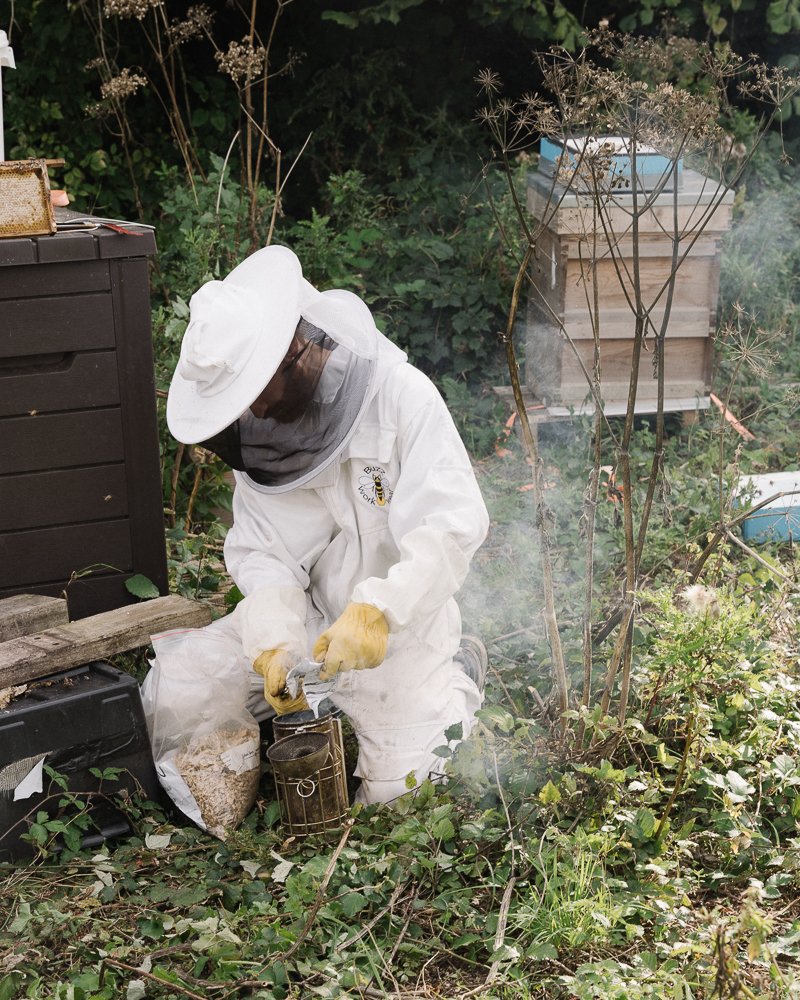
“When you wear the protective suit and you’re surrounded by tens of thousands of buzzing bees, the whole experience is so immersive,” says Alzein. He adds that the grounding activity is especially powerful for people living with post-traumatic stress. “It’s more or less an addiction to me at this point,” he says.
Alzein’s unique coping strategy now resonates with many Londoners. In 2020, he launched Bees and Refugees – an environmental justice organisation dedicated to promoting beekeeping as a therapeutic, community-building practice for refugees and locals in London.
Initially, the group spread hives around West London with help from the Hammersmith and Fulham council. Since then, Bees and Refugees has flourished into a collection of nearly 500 volunteers who nurture hives, host beekeeping workshops and maintain a 5-acre farm in Sevenoaks. Many participants, Alzein says, are asylum seekers or children of migrants who feel connected to the cause.
“He said the day he started keeping bees in London was the first day he felt alive again.”
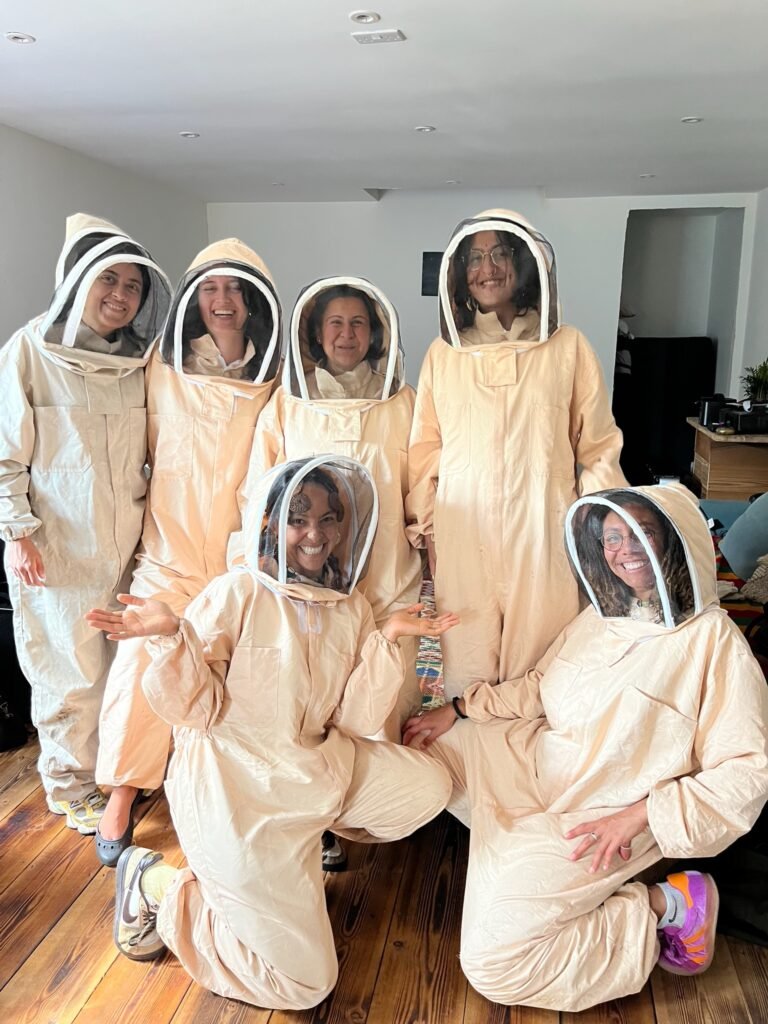
“They can just do farm duties uninterrupted,” says Alzein. “Others love to socialize and love the social impact we created on the farm.” Regardless of their style, everyone gets to take pride in caring for the hives’ European dark bees. According to Wageningen University & Research, the endangered species plays an important role in pollination and maintaining biodiversity.
“In the UK, they call it the British black bee. In the UK, they like to call everything British,” jokes Alzein.
Occasionally, Alzein travels between these very special hives by motorbike. One afternoon, still dressed in his beekeeping gear, he stopped for a bite at a Lebanese bakery in Shepherd’s Bush when a man began running towards him, speaking Arabic. The stranger turned out to be a former beekeeper, also from Syria, who was completely isolated from his passion after moving to the UK.
Naturally, Alzein introduced this stranger, who is now his co-beekeeper, to Bees and Refugees. And according to Alzein, “He said the day he started keeping bees in London was the first day he felt alive again.”
His friend’s rediscovery of a forgotten passion hit home for Alzein. He knew that beekeeping was exciting as a child in Al Ghutta and as an adult in London. But for many years in between, he wondered if he would die before knowing what he was truly passionate about, beyond the political unrest in Syria which eclipsed his early years.
As a child, Alzein says that he was “spoiled” and sheltered. At 17, he tried to give a love letter to a girl whose uncles were in the military, and did not approve of their relationship. When he reached the girl’s school, two undercover police were waiting outside. Alzein was arrested and tortured for a week.
“That was the first time I saw the government for what it is, and how inhumane life is. I was really traumatized after. My family learned where I was, they paid money and they got me out,” says Alzein. “I just wanted to leave Syria and be somewhere else.”
“When you wear the protective suit and you’re surrounded by tens of thousands of buzzing bees, the whole experience is so immersive”
So, Alzein spent a few years studying fashion in Spain. He returned to Syria to “be part of the civil rights movement” when the Arab Spring began, and worked for his parents’ clothing business. In 2014, he landed in London and spent six years working for Harrods – starting as a Christmas temp and working his way up to the retail manager at Dolce & Gabbana.
In that role, Alzein worked with clients who would spend tens of thousands of pounds on clothes, while his own community members struggled to get the basics. “It’s this complete shift from one of the most toxic environments to one of the loveliest, kindest sectors. I’m working with farmers, with beekeepers, with refugees, asylum seekers,” he says, reflecting on his journey. “I’m very happy. Even though I’m earning 90 per cent less than I used to, this is a much happier place.”
This summer, Alzein expects the farm to be “buzzing”. Londoners will come to lend a hand with renovations, share a meal and maintain the hives. “We’re really inspired by how bees work,” he says. “60,000 bees living in one house and they work as one. They have a hive mind and they function together, they support each other.”