
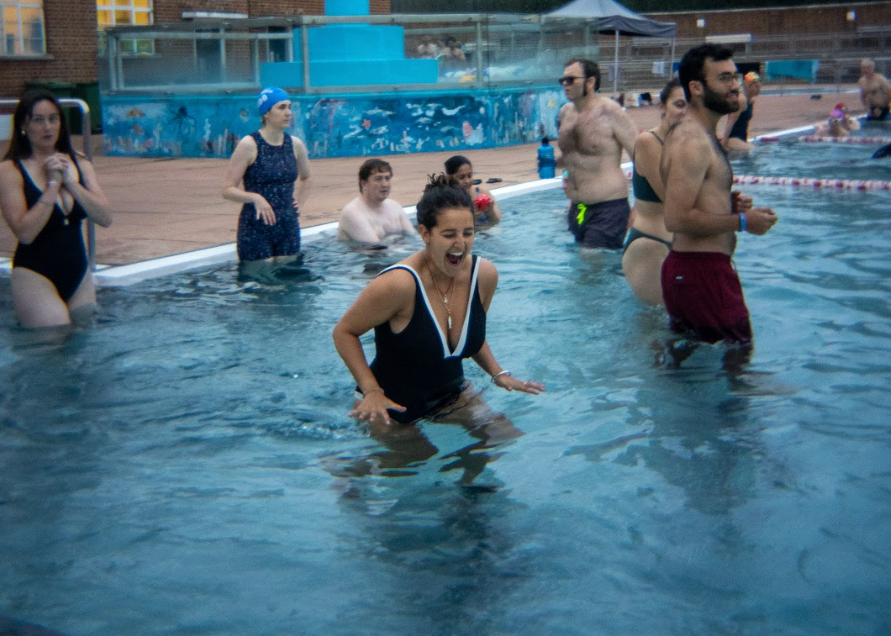
Propelled by evidence that cold dips can boost your mood, young Londoners are forgoing comfort and diving head-first into icy waters.
For many young people, a Sunday morning in London is spent in bed, snoozing off the debauchery of the night before or the looming responsibilities of the week ahead. Others may be among the swathes of Gen Z-ers heading to the gym as memberships continue to boom. But at London’s handful of open water locations across the city, more and more twenty-somethings can be found braving the cold and starting their Sundays with a swim.
On 12 February 2026, the government announced a proposal to establish 13 new bathing spots across England, including one on the River Thames at Ham and Kensington. Although London has its fair share of lidos and ponds, this will be the first ever designated bathing location on the Thames itself. The decision reflects a nationwide commitment to connect more people with blue spaces and could lead to significant improvements in wellbeing, particularly in cities like London.
Saxon Norgard, 32, set up a casual cold water swimming club called Swim Peeps in September 2024. The group quickly gained popularity and now has 1,300 members who meet at West Reservoir in Hackney every Sunday for a dip and a trip to the café.
“Growing up in Australia, I didn’t realise how important it was for me to have access to bodies of water,” Norgard says. “In London, it’s very easy to get caught up in the hustle and bustle – you’re rushing for the Tube, running at a million miles an hour, and there’s never enough time.”
There are a number of similar clubs emerging around London that focus on the social aspect rather than competitive lane swimming. “We’ve noticed that in the last 18 months or so, social swimming has really taken off,” Norgard says. “Young people are completely oversaturated with forms of connection that rely on digital media and are craving authentic ways to connect that aren’t just going to the pub.”
It’s not that Swim Peeps is opposed to the pub (Norgard has started organising nights out followed by a morning dip), but cold water swimming also has a number of mental health benefits that people are seeking out. “The beauty of cold water is that it completely shuts off your brain,” Norgard says. “Once you’re in, you can’t have any sort of social anxiety because your entire brain goes into survival mode.”
“Once you’re in, you can’t have any sort of social anxiety because your entire brain goes into survival mode.”
Laughing, he adds: “That might not sound great, but it’s actually really good for your mental health because it silences all the other noise. It stops you from worrying about what other people think of you, or whether you look good.”
Liv Sharron, 27, set up Chilly Dippers in 2018 while at university in Edinburgh. She moved back to London in 2024 and runs monthly cold water dips at Parliament Hill Lido in Hampstead. Like Norgard, she’s passionate about the benefits of being in the open water.
“I love the name Chilly Dippers because we’re not swimmers, you don’t need to be in the cold for very long to feel the benefits,” she says. “The endorphins are an instant fix.”
Being so close to the sea in Edinburgh, Sharron started cold water swimming whenever she felt overwhelmed or stressed with work. It made her feel good, and she wanted to persuade her friends to join her.
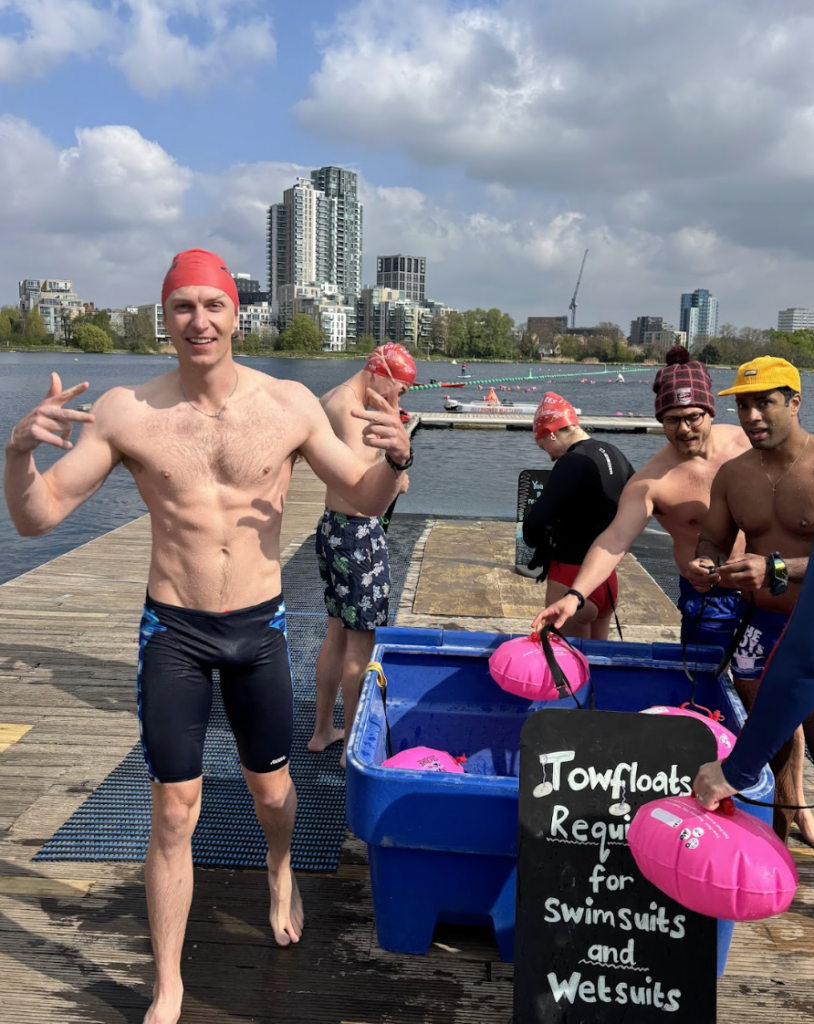
“It was the deepest, darkest depths of winter and I decided to host a group swim,” she says. “Everyone thought I was crazy.” But she proved them wrong – 100 students turned up to the first swim and the group has steadily grown from there, now with a strong base in London and nearly 5,000 followers on Instagram.
In January this year, Chilly Dippers hosted a collaborative dip with suicide bereavement charity Suicide&Co and male-only cold water group IceBreakers. “The rate of suicide is really high after the Christmas period,” Sharron explains. “So I wanted to hold a community event centred around bringing people together.”
The water temperature was only two degrees Celsius at Parliament Hill Lido, but that didn’t stop 60 people turning up for the joint event. “It felt really nice to see this blending of two communities,” Sharron says. “We didn’t know each other but it felt like a very sweet dysfunctional family.”
Claire Sakurai, 24, also started cold water swimming in Edinburgh. After spending a few Sunday mornings running into the freezing Scottish sea, she quickly became addicted to the rush of adrenaline it created. Now living in London, Sakurai is looking to join a local swimming group and recreate that experience.
“You become more in tune with your body because you have to be aware of your breathing to make sure you can handle the cold,” she says. “The shock is horrible at first but then you get used to it, and with the beautiful landscapes around you, you feel really at one with nature.”
Sakurai is the first to admit that she used to find traditional forms of meditation and breathing exercises “cringe”. But learning to regulate her nervous system in cold water made her more comfortable taking on other meditative practices like yoga. “It’s a chance to be in your body and not in your head,” she says.
“It’s a chance to be in your body and not in your head.”
There’s a growing scientific interest in outdoor swimming as an alternative form of therapy. Heather Massey is co-chief investigator on OUTSIDE: a study run by the Sussex Partnership NHS Foundation Trust that is investigating outdoor swimming as an intervention for depression. She says that the study is different to a standard mental health intervention as the participants are not required to talk about their depression during the swimming sessions.
“You’re outdoors, in nature, doing a group activity and you’re not talking about your mental health,” Massey explains. “You’re gaining mastery over an activity and learning about your local environment too – it’s a complex matrix that has an impact on your physiology, psychology and awareness of community.”
There’s a vulnerability to wild swimming that breaks down many of the social barriers that Gen Z feel anxious about today. Finding a shared interest in stripping off your clothes and subjecting your body to intense cold has a certain way of bonding people more quickly than in other circumstances.
“What’s been really powerful about these swim clubs is people have realised that, oh shit, there’s actually loads of young people who are doing this,” Norgard reflects. “They realise that it doesn’t have to be this solitary, wellness, ‘woo-woo’ activity.”
“I’ve made so many close friends through doing this,” he continues. “It’s quite remarkable how easily that seems to happen.”