
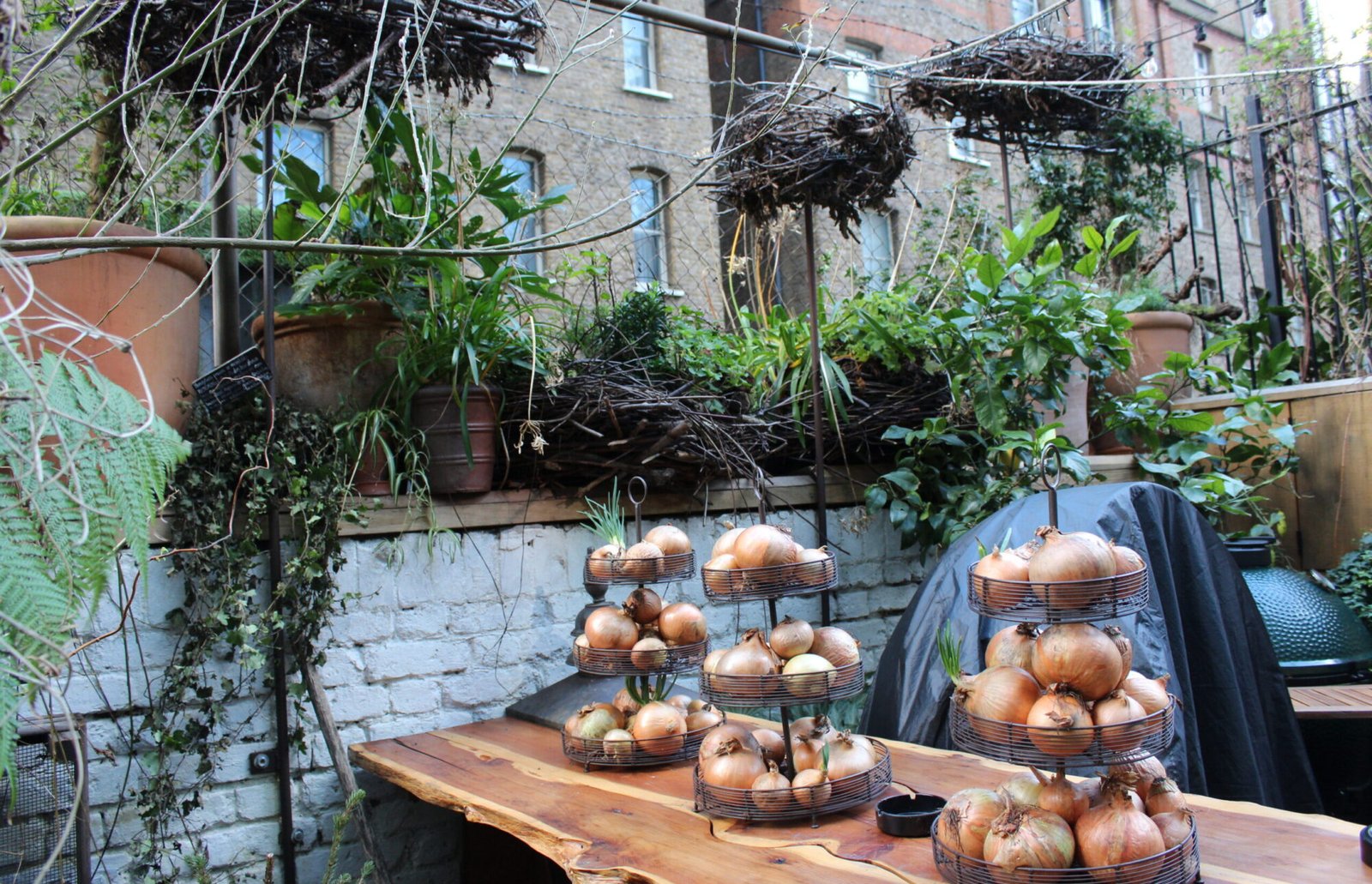
Beneath the city’s concrete jungle lies a serene oasis where onions bloom, blossom – and even form sculptures.
Walking around the stately avenues of Westminster, the last thing you’d expect to see when turning a corner is an abundance of onions. Yet on one late-February day, when I stumbled upon a small garden near St James’s Park, I encountered a profusion of the unassuming vegetable. They were growing from bulbs in soil, hanging from trees and arranged into sculptures.
Wandering further into the onion oasis, I found Jens Jakobsen, founder of London’s Onion Garden and self-described ‘Chief Onion’, who was busy with a trowel, digging away at a bed of soil surrounded by shrubbery. Five years ago, the former master florist transformed an unloved slab of concrete pavement with two trees into this pocket-sized garden, complete with a cafe, pavilion and greenhouse. Dwarfed by glass and concrete towers and just ten minutes from Westminster Abbey, it’s an unexpected but welcome flash of foliage.
Indeed, the humble onion might seem a curious choice for a themed garden, but it is richly symbolic. In many cultures, its rings represent eternal life. Jakobsen has certainly given the space a new lease of life – members of the homeless community who once occupied the space even return to relax alongside locals and tourists.
“Everybody is welcome here,” says Jakobsen. “The [homeless community] are allowed to come here whenever they want to. They find peace and no judgement. We respect them.”
“When you’re surrounded by nature, your happiness rises by 30 per cent.”
The garden, essentially a narrow, winding pathway, has many hideaway nooks and seating fixtures created from twigs and other natural materials. At the end of the garden is a verdant greenhouse, faintly onion-scented, that can be hired for events. Any profit goes toward the maintenance of the garden. Inside, it’s deadly silent aside from the occasional rumble of traffic beneath one’s feet – the garden sits directly above the District and Circle lines.
Home to over 160 plant species, Jakobsen’s curious corner has cultivated its own thriving environmental hub: lemon trees, daffodils, and countless wildflowers and herbs bloom year-round, attracting insects, butterflies and bees. Jakobsen grows everything organically, reusing natural materials in architectural features such as a large onion-heart sculpture and seating woven from twigs.
“We use everything – I don’t throw anything out,” says Jakobsen. He also uses other odds and ends from around the garden. Inserting copper wire into soil “helps keep plants happy” by interacting with magnetic fields and boosting nutrient absorption.
Jakobsen continues, “Scientists have found that when you’re surrounded by nature, your happiness rises by 30 per cent and your workflow increases by 20 per cent.” Despite the strange setting for a vegetable oasis, the Onion Garden is a popular Narnia-esque refuge for office-weary Londoners. “We can’t save the world with this project, not at all,” says Jakobsen. “But I can show people that with very little, you can create something which is so good for you.”